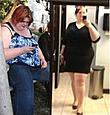
I can be your comparison right here - you are 40-30-39. I am 40-31-41. Pretty close, right? I wear a 8-10 in Calvin Klein - mostly 10 while you are wearing a 4? We have very little difference in measurements - but... your underbust is 28", mine is 34". You say your girth in your bottom is your butt (which whould mean smaller size) and mine is in my hips and gut (I have a flat butt). So, two girls - weighing about 12 pounds different of similar height and very similar measurements at first glance wear drastically different sizes - all by how our bodies are shaped - how our bones are shaped and where our fat lies.
It's crazy isn't it? I'd say in terms of pictures we don't look that much different either but just due to how we carry the weight/different proportions we get some pretty drastic differences in clothing sizes!
I remember in high school be floored because a friend of mine said she was a size 12 (when I was wearing a size 8) but yet she was always one my friends that I thought was about the same size as me. Another time I had the same reaction when a friend who I thought was much smaller than me wore about the same pants size as me. The point of it all is that one piece of clothing doesn't necessarily defend your entire shape. A size 6 on one women might look much smaller than on another depending on so many factors so it's always seems so silly to me when men and women try to define a cut-off between fat and thin based on clothing size alone.
But see, this is what gets me. I read the article that Kaplods is getting her info from and it makes sense - to a point.
I mean, I can understand wanting to make 10 the middle size, but it doesn't work and here's why.
Let's say when the started they made sizes 0-20 with 10 being the average sized woman. And they got this number in 1940. Well, people's nutrition got better. People grew taller. People got more fit, etc and so the sizes creeped up a bit - so now there is a 0-20 and what used to be a 10 is now an 8. The changes in sizes isn't so drastic that they still can have a 0-20 range. Then maybe seeing an untapped market of plus sized people and seeing growing numbers of plus size people, they start making sizes to 26. OK fine.
I'm making this up, but bear with me.
So, people start getting fatter in general. More and more people are needing sizes in 20 and up. So, the designer decides to start expanding their line to accomodate the increasing numbers of plus sized people. Well.... there are still tiny little skinny people. It's not like EVERYONE got fat!
So what happens to the 0 size if the designer decides to shift the rest of the sizes to the left? It becomes a 00. and the new 10 is what used to be a 14.
But can you keep making that shift and WHY????
Wouldn't it make a LOT more sense to just add sizes instead of creating 00s? Kaplods mentioned the average size now is a 14 so it's about time for another shift, but how can they do that? A 00 becomes a 0000? So now our sizes go 0000-30? Wouldn't it make more sense to be 0-36 or so?
And while people can claim it's not vanity sizing - it is. And it is because the designers are playing mind games with us. There is no big announcement saying "Attention everyone - starting today your size 10 dress will now be a size 8!!!) No, the sneakily change it and then if we gainers (which is the majority of Americans, unfortunately) don't really notice that the 10s from before are smaller than the 10s now. We are just happy to be buying a size 10.
And it remains super confusing. I do a lot of searching at consignment shops while on this weight loss journey. One of the designers I like is Talbots. Back in the early 90s I found their sizes ran small. Where I could wear an 18 elsewhere, I needed their 20. Then somewhere along the line they changed - a lot. Now I can wear their 8 when I wear a 10 most other places. In my closet I have a size 16 wool skirt by LLbean. Now I wear a 10 LLbean - so, one day I can be wearing the 17 year old size 16 skirt and next day wear their current day size 10 skirt. So, at these consignment shops I have to eyeball things to get an idea if these are OLD sizes or new sizes - by the same designer. Just last week I grabbed a bunch of size 14 dresses from Talbots at the consignment shop - hoping these were there 'old sizes', but alas, they were too big.
So, it's confusing, it means we need to go to negative sizes practically for the really tiny girls and it allows us to be comfortable with our expanding waistline because we wear the same size as always.
That "I" at 172 pounds can wear anywhere from a 6-12 in clothes (mostly 10s) is ridiculous. I have a large frame. I'm not at my ideal weight and I'm wearing a 10. Two decades ago I was wearing a 16 which was the end of the regular sizes and beginning of the plus sizes. Now I'm nowhere near the plus size line - yet I have the same weight and shape as then. So, I think there is vanity stuff going on. Designers aren't saying it like it is - MOST of us are plus size. Sure, the average might be higher than ever and they should design for who's out there, but we all should get real and realize that MOST of us are plus size and could use to lose some weight.
I get what you're saying. I think vanity sizing enables denial too and it bugs me b/c you don't know what size you really are from one brand to the next sometimes.
I am not really having this issue though. I weight the same now as I did a decade ago and the same pants are looser than they were back then. I know that I am in better shape from exercise and since I know my pants haven't changed size, I can only assume the weight shifted to other areas of my body or my amount of exercise has widdled me down to be a bit smaller at this weight than I previously was with less exercise. I dunno. Just a thought...
But see, this is what gets me. I read the article that Kaplods is getting her info from and it makes sense - to a point...
Wouldn't it make a LOT more sense to just add sizes instead of creating 00s? Kaplods mentioned the average size now is a 14 so it's about time for another shift, but how can they do that? A 00 becomes a 0000? So now our sizes go 0000-30? Wouldn't it make more sense to be 0-36 or so?
.
The sizes wouldn't "shift" because the recalibration was supposed to be calculated just like the first ones were - by normal distribution - that is a bell curve. Think of it like grading on the curve in school. When you grade on the curve, the highest score is assigned an A and the losest score is assigned an F, and 50% of the scores (if you're following a true bell curve) should be assigned a C. You don't have to add a grade higher than A or a grade lower than F, you just adjust the grades to fit the curve.
That IS confusing, and when I said we're "overdue" for a new resizing, I didn't mean it literally. I meant it in the sense that we would be overdue, if sizes were being implemented the way they were originally intended to be.
And I think the fault lies in lack of foresight. The creators of the system did not realize how much the female figure would change (even among the thinnest women our bust sizes are a full cup or more larger than they were in the 40's), nor did they have any plan for implementing and communicating future changes.
Again, just another way the "system" that was created has been a failure from the very start.
Another aspect of sizing that the original creators didn't account for, is the whole "ready-to-wear" concept. It was generally assumed that women would continue to have their clothing altered, so getting clothes to fit every woman well without the need for alterations was never part of the original goal. The focus was more on creating a garment that could easily be altered (the measurements were always meant to be guidelines for purchase, not guarantees that the garment would fit everyone "off-the-rack."
A good part of the confusion arises because we're using sizes in a way that was never intended. If we want ready-to-wear, no-alterations-needed clothing, we need a lot more sizes than we have, because we have to accomodate more shapes.
You see some of that in jeans now, with cuts to fit different shapes. I love Fashion Bug and Lane Bryant's "Right Fit" Jeans that came in three lengths, three colors (indicating body shape) and a range of sizes from 1 to 9.
That means there were 81 different "sizes."
I was a blue 8 (now a blue 7) in the average length. Blue was for "curvy" (pear shaped) women.
Unfortunatley I've heard that they've discontinuing the line, so I'll be hunting for them at Goodwill and other thrift stores (found my first thrift store pair a couple months ago).
You see some of that in jeans now, with cuts to fit different shapes. I love Fashion Bug and Lane Bryant's "Right Fit" Jeans that came in three lengths, three colors (indicating body shape) and a range of sizes from 1 to 9.
That means there were 81 different "sizes."
I was a blue 8 (now a blue 7) in the average length. Blue was for "curvy" (pear shaped) women.
Unfortunatley I've heard that they've discontinuing the line, so I'll be hunting for them at Goodwill and other thrift stores (found my first thrift store pair a couple months ago).
That's really strange that they're dicontinuing that line! If anything I've seen manufacturers moving more towards extra sizes (Levi's Curve Id jeans, for instance, seem to be doing well). Also, in tops BiuBiu, Aj Rumina, Carissa Rose, Campbell and Kate shirts, Pepperberry and others all have two sizes (bust and waist) and all seem to be doing quite well.
That's really strange that they're dicontinuing that line! If anything I've seen manufacturers moving more towards extra sizes (Levi's Curve Id jeans, for instance, seem to be doing well). Also, in tops BiuBiu, Aj Rumina, Carissa Rose, Campbell and Kate shirts, Pepperberry and others all have two sizes (bust and waist) and all seem to be doing quite well.
They're supposedly coming out with a similar line, but they've renamed it and the numbering system is no longer going to be 1 through 9, but rather standard misses sizes (such as 12 through 28).
It's supposed to be "less confusing," because the sizes are consistent with the other clothing sizes in the store, but I had just gotten used to the RightFit system, and there's no gurantee that the new sizes will fit the same way.
They're supposedly coming out with a similar line, but they've renamed it and the numbering system is no longer going to be 1 through 9, but rather standard misses sizes (such as 12 through 28).
It's supposed to be "less confusing," because the sizes are consistent with the other clothing sizes in the store, but I had just gotten used to the RightFit system, and there's no gurantee that the new sizes will fit the same way.
Oh ok. Well, hopefully they still fit well. I was pretty surprised to hear that they would discontinue a line like that because it seems like more and more stores are moving in that direction.
The sizes wouldn't "shift" because the recalibration was supposed to be calculated just like the first ones were - by normal distribution - that is a bell curve. Think of it like grading on the curve in school. When you grade on the curve, the highest score is assigned an A and the losest score is assigned an F, and 50% of the scores (if you're following a true bell curve) should be assigned a C. You don't have to add a grade higher than A or a grade lower than F, you just adjust the grades to fit the curve.
And imagine if they were to keep doing that? We would have 3-5 inches between sizes - like taking the 00 and 0 be one size, the 2 and 4 be one size and so on - Everyone would have to alter unless you were one of the lucky ones right at that measure.
Quote:
Originally Posted by kaplods
That IS confusing, and when I said we're "overdue" for a new resizing, I didn't mean it literally. I meant it in the sense that we would be overdue, if sizes were being implemented the way they were originally intended to be.
Oh, I know you weren't being literal. I was saying, "Just imagine if it happened."
Quote:
Originally Posted by kaplods
And I think the fault lies in lack of foresight. The creators of the system did not realize how much the female figure would change (even among the thinnest women our bust sizes are a full cup or more larger than they were in the 40's), nor did they have any plan for implementing and communicating future changes.
Again, just another way the "system" that was created has been a failure from the very start.
Another aspect of sizing that the original creators didn't account for, is the whole "ready-to-wear" concept. It was generally assumed that women would continue to have their clothing altered, so getting clothes to fit every woman well without the need for alterations was never part of the original goal. The focus was more on creating a garment that could easily be altered (the measurements were always meant to be guidelines for purchase, not guarantees that the garment would fit everyone "off-the-rack."
A good part of the confusion arises because we're using sizes in a way that was never intended. If we want ready-to-wear, no-alterations-needed clothing, we need a lot more sizes than we have, because we have to accomodate more shapes.
Hmm... I thought the article I read said that they came up with these sizes for the ready to wear items. But I could be totally wrong and of coruse I didn't bookmark that article as per usual me.
Quote:
Originally Posted by kaplods
You see some of that in jeans now, with cuts to fit different shapes. I love Fashion Bug and Lane Bryant's "Right Fit" Jeans that came in three lengths, three colors (indicating body shape) and a range of sizes from 1 to 9.
That means there were 81 different "sizes."
I was a blue 8 (now a blue 7) in the average length. Blue was for "curvy" (pear shaped) women.
Unfortunatley I've heard that they've discontinuing the line, so I'll be hunting for them at Goodwill and other thrift stores (found my first thrift store pair a couple months ago).
That's kind of why certain designers work for me and others don't. Like I skip RIGHT by the Limited selections in the outlet stores. Their pants are all wrong for me.
Hmm... I thought the article I read said that they came up with these sizes for the ready to wear items. But I could be totally wrong and of coruse I didn't bookmark that article as per usual me.
I was using "ready to wear" in a slightly different context than it was being used "back then."
"Ready to wear" didn't mean that the clothes wouldn't need to be altered (it still doesn't really man that today. If you're very short, or have other figure issues you may have to have your clothing altered to fit properly). Ready to wear meant (and I guess still technically does) that the clothing was mass produced and made without a specific person in mind. That is, the opposite of "tailor made for a single individual person."
The mass produced clothing was called ready-to-wear, even though the hems of skirt, slacks, blouses and sleeve cuffs were often unfinished. So technically, some weren't quite so much "ready to wear" as "ready to try on." Even when more and more of the garments were completely finished and were therefore more literally ready-to-wear (but only if you just happened to fit perfectly into the manufacturer's size), most reputable department stores (not just the higher-end ones) offerred free alterations (or mor accurately, it ws figured in to the purchase price of the garment).
For some reason (maybe because they assumed most women could do the alterations themselves) department stores stopped offering free alterations for women's clothing but continued to offer free alterations for men (and in fact, some still do).
So, this inspired some research. And by research, I mean calling my doctor's office and asking them weird questions. To my credit, I did qualify my question by saying, "so, this is probably the weirdest question you're gonna have today, but..."
I currently weight 227 pounds, and am 28 years old (soon to be 29! Prime numbers FTW!). I wear a size 16 or a size 18, depending on where I buy my jeans. Usually it's 16, but a couple of places are eighteen. Clothing size-wise, this is precisely where I was in high school.
According to my doctor's office (where my chart number is 2, so I can remember it), I weighed 194 pounds my senior year of high school, and 198 pounds before my junior year of high school. Now, there may be some differences in distribution and muscle mass in that my high school self had never seen the inside of a gym, and also in that I am no longer a teenager. However, I'm still the same person, and that's not a small difference--that's 33 pounds.
So take that data point for what it is. Also, my driver's license says 175. I was such a liar.
I was using "ready to wear" in a slightly different context than it was being used "back then."
"Ready to wear" didn't mean that the clothes wouldn't need to be altered (it still doesn't really man that today. If you're very short, or have other figure issues you may have to have your clothing altered to fit properly). Ready to wear meant (and I guess still technically does) that the clothing was mass produced and made without a specific person in mind. That is, the opposite of "tailor made for a single individual person."
The mass produced clothing was called ready-to-wear, even though the hems of skirt, slacks, blouses and sleeve cuffs were often unfinished. So technically, some weren't quite so much "ready to wear" as "ready to try on." Even when more and more of the garments were completely finished and were therefore more literally ready-to-wear (but only if you just happened to fit perfectly into the manufacturer's size), most reputable department stores (not just the higher-end ones) offerred free alterations (or mor accurately, it ws figured in to the purchase price of the garment).
For some reason (maybe because they assumed most women could do the alterations themselves) department stores stopped offering free alterations for women's clothing but continued to offer free alterations for men (and in fact, some still do).
I have decided that when I get to goal, I will have my clothes tailored to fit me. It is so incredibly cheap to do. What I do now is try on a dress and see it is too tight in the boobs if I want to fit my hips. I should just see if it's a good style and then buy the size to fit my boobs and have a seamstress take in the waist and hips to fit me properly.
Pants are a bit different because there is more to it - where the waist hits, wherer the crotch hits, length, position of pockets, etc, but men's dress pants are altered all the time in all directions. Wouldn't it be nic ego have clothes that really look like they fit well?
This makes me curious about the 14's I wore back in 1995, when I weighed 220 pounds. I wish I still had them and wonder what size I'll be in once I get back to that weight.
Last weekend I was curious about sizes too. I've lost 52 lbs and am still about 38-40 lbs more than I was in H.S. An exercise physiologist at the gym measured my body fat a month ago and supposedly my lean mass is about the weight I was in H.S. Anyhow...I have my prom dresses from my Junior and Senior years in H.S. and tried them on last weekend..thinking about the size I was then and that I wear a 14 now and a 12 in some clothes. Not even close. The senior dress (a 12 back then) could barely get over my hips and then was nearly impossible to get off. Zipper wasn't even close to zipping. The Junior dress was a 10. Umm...couldn't get it above my thighs.
Tim Gunn talked on the Revolution show a week or two ago that sizes went up around 1986, mid 1990's and early 2000's. This made me feel better to be honest. I'm 5'11 and when I read about actresses around my height wearing size 6, I'm honest when I say..."what? how? there is no way..." It honestly makes me feel better knowing that the sizes have changed over the years and what they are wearing is the size 10 that I wore in H.S. Maybe this goes back to the fact that I always felt like I was so big compared to my HS friends because they wore much smaller sizes than me. When I look at pictures from back then they are much shorter but not that much smaller than me in those pictures.
I've been expanding my shopping horizons, and looking at online plus size stores, mostly in the US. The difference in sizing between here and there is insane! I found some perfect dresses on a site a few months ago, and was over the moon when I saw that they went to 4X! So now, a few months down the road, and into a 2X top (bottom's still pretty close to 4X) I go to order a dress for my SIL's staggette. I looked at the size chart, and there is no way in **** my boobs or my gut are going into a 4X. So I pulled up the size chart for the store I shop at here, and there is a TEN INCH difference in a 4X here vs there! Needless to say, I will not be into one of those dresses by May
This isn't the first time I've had this problem. I ordered a tank top from Hips and Curves that I wanted baggy, for a sleep shirt, so I ordered it in a 5X. It fits like a glove, just like the 2X one I bought up here
Boo. I really wish I would have looked months ago at the size chart. I didn't think there would be nearly A FOOT difference in size.
Sigh.....even when I'm little, I'm going to be wearing X's.
Years ago I weighed 92-95 lbs and was a true size 0,1,3 Petite!
Now I am sitting here in a Junior size small top
And Levi Jeans non stretch Size 2
I guess they figure if we lie to them they will buy...and they are right!
Now if they start making wide shoes and label them Narrow I can lose my Duck feet ( born with club feet) and I will buy more shoes since it is hard for me to find shoes that fit properly
Just like ice Cream was kept at a certain Price Point so consumers would continue to purchase it ,clothing manufacturers have jumped on board to make us feel better about ourselves and.....Spend money and we can live in the land of denial!
Roo2
When I was about 220 (maybe the two teens) I went to a fitness shop to buy some fitness clothes as I had nothing for working out. I was just starting to go to the gym too.
Well, I was going through the racks and I was so, so happy to see that there were 16 and XL. I though they would just be these tiny sizes. Then I overheard a very petite and very fit woman talking with her husband, "I don't know why they make so many large sizes. Like large people are going to be wearing fitness clothes?"
I wanted to smack her, but I also wasn't feeling confident in the fitness department yet as I was just really starting with more than just walking.
Reality is, there are a LOT of us bigger people AND they work out too!
Now... move on to last spring - a year later. I am now 165 pounds and very fit. I can run, I can jump. I can do most anything a typical fairly fit 42 year old woman can do. I still needed to buy a size large in EVERYTHING and I never, ever will be small enough to wear less than a Large as I am built large and I have big boobs. Would this same lady say that about the larger sizes if she saw me then as I was obviously fairly fit?
You are nearly 6 inches taller than me and if you have a large frame, you will never be able to fit into dinky sizes either. That's just a reality, but it doesn't mean you will LOOK big - you won't!
Also, now I can feel really good that I am wearing 10s and got down to 8s, but what does it mean? Just last week I was wearing my wool pleated skirt from 1994 in a size 16 and it's slightly snug. It fit perfect when I was 10 pounds lighter. That same store I'm now a 12 in today's sizing.
It's a head games. I'm not 'smaller' now - the 10 and 16 fit the same me. Everyone else is just bigger so they made the sizes reflect the median, again (and again, and again). In dressmaker's sizes I'm a 20 or 22... I forget.
AND it gets extremely frustrating when trying to order clothes as even their stated sizes to inches isn't helpful. I wear a lot of Calvin Klein and Ralph Lauren. According to their size charts I should be wearing a 12 in RL and an 8 in CK. At my thinnest I was wearing an 8 CK, but according to their chart I should have been a 4. Um, I don't think so - I have HIPS! I wear a 10 comfortably now. According to RL I should currently be wearing a 14, but I'm wearing a 10 comfortably. It all depends on shape - amount of fat versus muscle, etc.
So, try not to get too downhearted about sizing. Even if you ALWAYS stay in an X size, there is a HUGE, HUGE, HUGE difference between a 5X and a 1X. And on a tall body? You'll look even slimmer. And also realize that those numbers mean SQUAT!!!!
Last edited by berryblondeboys; 02-26-2013 at 04:26 PM.


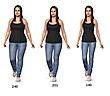


 I'd say in terms of pictures we don't look that much different either but just due to how we carry the weight/different proportions we get some pretty drastic differences in clothing sizes!


 I was pretty surprised to hear that they would discontinue a line like that because it seems like more and more stores are moving in that direction.




 Anyhow...I have my prom dresses from my Junior and Senior years in H.S. and tried them on last weekend..thinking about the size I was then and that I wear a 14 now and a 12 in some clothes. Not even close. The senior dress (a 12 back then) could barely get over my hips and then was nearly impossible to get off. Zipper wasn't even close to zipping. The Junior dress was a 10. Umm...couldn't get it above my thighs.