I am 20, 5'1, and I weigh about 98 pounds. I have been dieting for about 10 months now and I lost about 10 pounds. For the past two months I have been on a 400 calorie deficit per day ( I am eating 400 calories less than I am burning per day) and I do cardio and weights 3 times per week. I go to college so I also probably walk around 2 hours per day to and from and around campus.
I just got my body fat measured and, to my disappointment, I have 28% body fat. For females, fitness is 21-24% and average is 25-31%. This is pretty devastating for me. I thought I would definitely be within the fitness range since my bmi is 18.7. I just can't get that percentage out of my head. I don't understand how I can have so much body fat with the amount of exercise that I am doing. It would make sense if I was sedentary but I am definitely not. This should not be happening.
I got measured for a class and we used 3 different types of techniques; bio electrical impedance, nir, and tricep skinfold. I had my bei measured on two different days. The 1st day i got 18% and the 2nd i got 24%. Both my nir and tricep skinfold were 28%.
So what is going on? I really have no idea what else I should be doing to lose fat.
It's not an overweight percentage, and the "fitness" percentage you mention is usually only found in long-term athletes, people who work out or compete consistently.
It seems to me that you're doing fine. At your small size, if you want to lose fat, perhaps it's not a matter of dieting but building muscle. replacing some of your cardio with weight training should help with that.
It's colloquially known as 'skinny fat' and does indeed happen when someone is losing weight but not building lean mass, or is naturally slender but not fit. It sounds like you're exercising, which is excellent, but the type of exercise matters. Cardio isn't going to build up lean mass significantly, it won't help with this. Strength training is what will best improve this and get you a healthier body fat composition (and you're not that far from ideal, don't be too concerned).
Do body resistance exercises like lunges/push-ups/planks/squats/etc. Lift heavy weights to failure, no tiny weights and a million reps! That will do he job you want it to do, of strengthening your body while burning fat. Body recomposition is what you need to combat this, not weight loss
Last edited by Arctic Mama; 11-17-2012 at 12:22 PM.
Do body resistance exercises like lunges/push-ups/planks/squats/etc. Lift heavy weights to failure, no tiny weights and a million reps! That will do he job you want it to do, of strengthening your body while burning fat. Body recomposition is what you need to combat this, not weight loss
Thank you for the reply. This is already what I am doing though. I lift weights to failure and I do pushups and lunges when I go to the gym. Do I need to be eating at maintenance level in order to gain muscle? I feel like my problem is my diet.
Thank you for the reply. This is already what I am doing though. I lift weights to failure and I do pushups and lunges when I go to the gym. Do I need to be eating at maintenance level in order to gain muscle? I feel like my problem is my diet.
At your weight and weight, you'll need to eat over maintenance to gain muscle. Gaining muscle/a "fit" body will take more patience then just weight loss - you'll need to eat more, lift hard, and be PATIENT as it can take many months (if not years) to really build muscle and then lose the fat after.
Body fat is only one part of the equation, muscle mass is the other. When you are missing the muscle mass, you're a smaller version but not necessarily leaner.
Bioimpedance monitors have a degree of accuracy of about 8% for measuring body fat so if it says 18% you could be as low as 12% or as high as 26%.
Caliper measurements can be good if the person taking them knows what they're doing but if they only measured your tricep than depending on where you hold your fat it could be wildly inaccurate.
NIR also can be problematic especially if they used single site measurement like the caliper test.
My point is that you don't know what your body fat percentage is but based on the information I have it seems most likely to be low to mid twenties.
As for how to best achieve your goals I really wouldn't be able to say based on the information I have but it's probably a good idea to try and maintain for a time while lifting heavy.
At your weight and weight, you'll need to eat over maintenance to gain muscle. Gaining muscle/a "fit" body will take more patience then just weight loss - you'll need to eat more, lift hard, and be PATIENT as it can take many months (if not years) to really build muscle and then lose the fat after.
Body fat is only one part of the equation, muscle mass is the other. When you are missing the muscle mass, you're a smaller version but not necessarily leaner.
Is it possible that all this dieting and exercise has made me fatter by losing more muscle than fat? I really wish i knew my body fat percentage before I started. I am so afraid that most of my weight loss came from muscle. I am losing a pound a month when I should be losing about 3 1/2. I am almost maintaining with the amount I am currently eating. So, my metabolism must be slowed down. I know that I need to eat more to gain muscle but I am worried that I am going to gain a lot of fat as well.
If you're already lifting that is excellent! Then I'd definitely agree with Sacha, eat above maintenance to build muscle mass. There are plenty of EXCELLENT plans for this - Leangains, Phinney and Volek's "The Art and Science of Low Carb Performance", "New Rules of Lifting for Women", you name it. Lots of options depending on your own habits and preferences.
And John raises an excellent point I'd missed, for some reason I was thinking you calculated your body fat by hydrostatic weighing, but rereading your post I see that isn't the case. The error margin on those is significant. If you're strong, have the endurance you want, and like the way you look in the mirror, chances are your body fat is just fine and you're falling outside the median accuracy on those measurements. Keep that in mind, as a reproductive aged woman you're going to carry slightly more body fat, especially through the lower belly, hips, and thighs. Leaning that out is not necessary, and you can still have very healthy body fat percentages without being down into the lower end of the fit range.
Just some food for thought. There is almost always room for improvement, but if you're JUST basing this on these measurements and no other litmus, the reminder about their accuracy is very important! They're flawed and approximate testing methods, keep that in mind
Is it possible that all this dieting and exercise has made me fatter by losing more muscle than fat? I really wish i knew my body fat percentage before I started. I am so afraid that most of my weight loss came from muscle. I am losing a pound a month when I should be losing about 3 1/2. I am almost maintaining with the amount I am currently eating. So, my metabolism must be slowed down. I know that I need to eat more to gain muscle but I am worried that I am going to gain a lot of fat as well.
It depends on how you lost, slow losses at your size and BMI are NOT uncommon or unhealthy. But yes, you have likely lost some lean mass. Exercising as you have been is the BEST way to preserve that. As I mentioned in my post, now looks to be the time to focus in gaining real muscle mass with feeding AND injuring the tissue - ie: eat enough quality calories and work the body hard with full body, weight resisting exercises.
You can TOTALLY do this. No need to fret about your past dieting when a more desirable body composition is completely within your reach with time and hard work
It depends on how you lost, slow losses at your size and BMI are NOT uncommon or unhealthy. But yes, you have likely lost some lean mass. Exercising as you have been is the BEST way to preserve that. As I mentioned in my post, now looks to be the time to focus in gaining real muscle mass with feeding AND injuring the tissue - ie: eat enough quality calories and work the body hard with full body, weight resisting exercises.
You can TOTALLY do this. No need to fret about your past dieting when a more desirable body composition is completely within your reach with time and hard work
Is there a way to gain muscle by timing my meals better so I don't have to eat more? That way I can lose fat as well. What if I ate right after working out?
Is there a way to gain muscle by timing my meals better so I don't have to eat more? That way I can lose fat as well. What if I ate right after working out?
No. It isn't that fancy - it really is just a surplus of calories and resistance training. Do you have pictures you can share? Because the numbers you give indicate that you are undereating for your activity level and probably losing a decent amount of muscle mass with fat too. If the numbers are accurate, you are spinning your wheels aka. going backwards.
Again, I'd direct you to a program like Leangains for that, or NROLFW. Google them
They will give the details of how body recomposition is achieved with their specifics far better than my summarizing. My opinion is that meal timing is over-blown in the broscience-saturated world of lifting, unless we're taking fasting based plans. But you'll have to do your own research and figure out what works with yor body and goals. For me, it doesn't matter one whit.
Your gym must have a personal trainer available for consults, often the first one is free. Maybe have them check your workout routine and see if they can adjust it? I agree with the other posters that you need to be lifting high weight at low reps - if you aren't fighting out the 10th one of the first set , it's not enough weight. Really, each set should be more like 6-8 lifts. You should not be able to complete your last set. You also need to let the muscles build up for a day or two between workouts, or else they will not be able to build back up between rounds. Make sure you have a good rotation. Also, do a lot of abs/back - those muscles regenerate fast enough that you can do them daily, and they build fast!
You may want to consider that to a certain extent, these numbers that you're quoting are based on ideals. Not every body type is designed to have the same amount of fat, and it might be very hard for you to achieve the number that you are looking for. Also, very often those numbers (bmi, body fat etc.) are more accurate for people who are more to the average size for humans - as a shorter person, they may be more variable for your particular body type. It is very common for young women to have a little more 'baby fat' as their bodies are growing; you may still have some left over that you will just mature out of. If you are as strong as you want to be, and look like you want to look, maybe you need to let go of the number that you have decided you also 'have' to be.
ETA: It is entirely possible that you are losing muscle mass instead of fat if you are eating very low cal, and not enough carbs or protein. A personal trainer could tweak your diet too. I was taught to not eat before a workout (so you don't puke), but to always have something after with protein, carbs and potassium (pb & bananas on toast, for instance) to help replace electrolytes and give your muscles the stuff they need to rebuild.
No. It isn't that fancy - it really is just a surplus of calories and resistance training. Do you have pictures you can share? Because the numbers you give indicate that you are undereating for your activity level and probably losing a decent amount of muscle mass with fat too. If the numbers are accurate, you are spinning your wheels aka. going backwards.
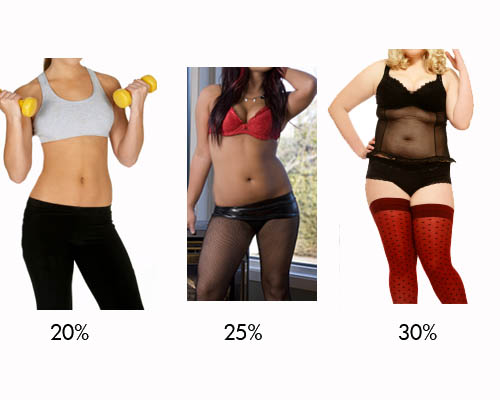
I don't want to post a picture but I honestly look most similar to the girl with 20% body fat. I am so confused about this because with 28% body fat I should look most similar to the girl on the right.
Quote:
Originally Posted by scoutycat
ETA: It is entirely possible that you are losing muscle mass instead of fat if you are eating very low cal, and not enough carbs or protein. A personal trainer could tweak your diet too. I was taught to not eat before a workout (so you don't puke), but to always have something after with protein, carbs and potassium (pb & bananas on toast, for instance) to help replace electrolytes and give your muscles the stuff they need to rebuild.
I know that the lower your calorie deficit is, the more muscle mass you lose with weight loss. That is why I specifically tried to keep my deficit in the 400 range. The fact that I am losing weight so slowly is proof that I am really eating at a fairly small deficit. I definitely am eating enough carbs and protein. The only time people lose more muscle than fat is when they are literally starving (like a deficit of more than 800). It just doesn't make any sense.
The whole body fat thing just drives me crazy! My home scale tells me I am 28-30% body fat, the gym (using calipers) tells me I am 19-22% body fat. I look like the 20% picture, too.
Lifting weights is great and all....but I don't and I believe you can still have a low body fat percentage.


 Low bmi, high body fat percentage!?!